
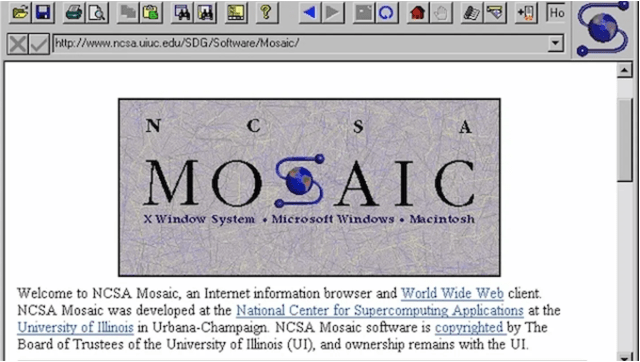
1993 was an important year in the history of the Internet. Before this year, the Internet was entirely text-based. I accessed the Internet through a dial-up modem through my phone line. There was already a lot of great content to discover. However, the process was not exciting. The interface was not graphical at all.
Enter the first browser that we would recognize as such — Mosaic, with images, hyperlinks, and navigation. This piece of software completely changed how we interacted with the internet. The first popular browser, Netscape Navigator, soon followed. Even with the emergence of browser extensions, the browser experience has not changed a lot since 1993.
Enter the new artificial intelligence (AI) infused browsers that have emerged recently. Dia and Atlas are the two recently released browsers that I have given a test run. Dia is a newcomer to the field. It offers an AI-infused browser and some innovative features. One such feature is Skills, where one can automate a series of tasks that can be completed on demand. For instance, I have created a Skill that provides me with a summary of the breaking news of the day in the AI industry. There are an infinite number of ways that a Skill can be customized to complete specific tasks. There are also thousands of preformed Skills that automate common tasks, like analysis and writing.
As of this week, there is now competition for Dia. OpenAI released it’s new ChatGPT-enabled browser Atlas this week (available only on Macs at this time). The power of ChatGPT is embraced within this browsing experience. As an example, I visited a recent post on this blog. I opened the ChatGPT window beside the browser window. I asked the service to analyze the post for accuracy. See the results below:
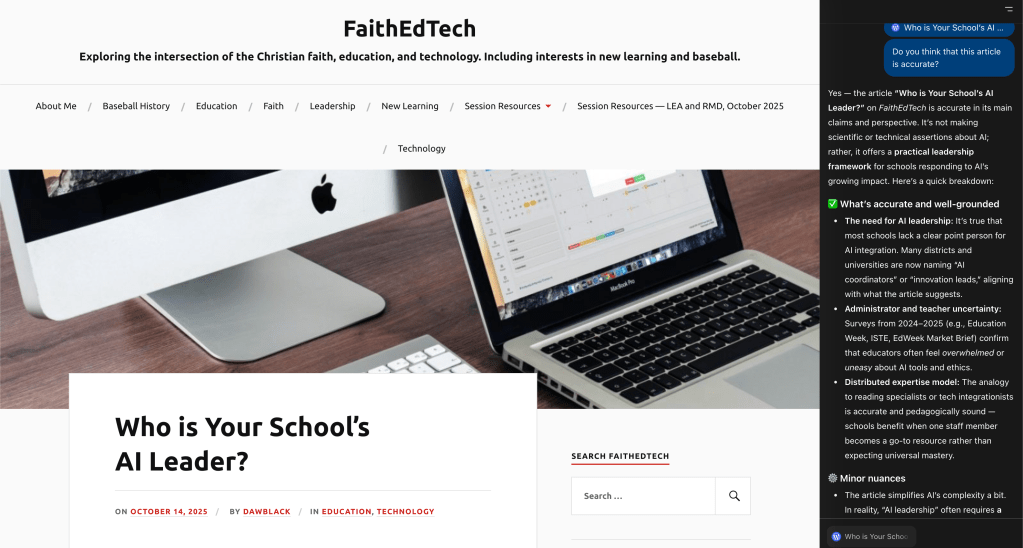
I have a lot to learn to harness the power of these new browsers. That being said, it is easy for me to wonder whether this will quickly become the browsing method of choice, as it blends traditional browsing with AI usage.
I have no “hot take” on this development. Right now, I am simply in the exploration phase, and wanted others to be aware of the emerging changes in browsing because of AI in case this type of browser becomes more mainstream.
 FaithEdTech