
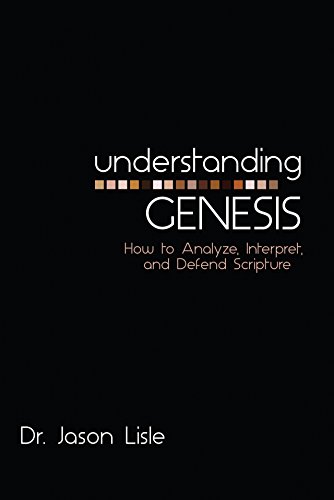
This morning I completed reading my 26th book of the year. Understanding Genesis, by Dr. Jason Lisle of the Institute for Creation Research, sat on my desk for several years before I picked it up once more and read through it over the past several weeks. I am glad I did because this was extremely helpful for me in explaining the truth of the Biblical creation narrative from both a logical and textual perspective. While I have always been compelled with these truths, Dr. Lisle provides many thinking and rhetorical tools to use in support of Genesis as historical truth.
The first part of the book reviews the many logical fallacies that Genesis critics use in their attempts to debunk a literal interpretation of the book. This discussion is helpful in that the strategies introduced by Lisle may be applied to other Biblical studies as well. Then the author uses these strategies to ably defend God’s creation of the world in six twenty-four hour days, the presence of a young earth, and the global flood at the time of Noah.
The final part of the book I found to be less helpful and something that strayed from the primary theme of the volume. In an extensive appendix, Lisle “debates” someone who denies both the Trinity and that Jesus Christ is truly God. While these defenses are interesting, they do not really fit with the content of the rest of the book.
Here are a few of the helpful thoughts for me from the book:
- The genre of Bible text matters greatly. Most of Genesis is history. Therefore, the purpose of the original author is straightforward, and should be treated as such. Where so many creation critics go wrong is they cite content from other genres found in the Bible, namely poetic writing, to discount the historical Biblical narrative.
- Reification is when a property is inappropriately applied to an abstract thought. Often, critics of a six day creation will use phrases such as, “The science shows that this took place over millions of years.” The Science is a fallacy since science, by nature, is contentious and constantly open to revision with new data. In addition, not all scientists agree. When The Science is used it is an attempt to discount a perspective without providing evidence. In the case of creation, this was not viewable by anyone except God, so to state this idea as a observable fact is another fallacy. The reification fallacy was used repeatedly during COVID, especially in relation to vaccines. One might believe that vaccines were extremely effective, but stating that The science showed that they were was a reification fallacy.
- The context of the text should ALWAYS be considered. There has been much debate over the use of the Hebrew word yom in Genesis 1. Yom typically means a 24-hour day, but there are a few times when it is used to explain a longer period of time. Six-day creation critics point to this as a reason why Genesis 1 supports a longer period of creation. However, they ignore the context of its use in Genesis 1. Yom is used along with the phrase, “and there was evening and there was morning.” With this context, clearly the author of Genesis was showing that the days of creation were truly 24-hour days, not periods of time or eras.
- Scripture interprets Scripture. Where there might seem to be a discrepancy between two verses, those verses from a historical perspective and straightforward prose are always used to interpret poetry and creative literary forms found in the Bible, not the other way around.
Certainly I could go on with the learning from this book, but I hope this provides a basic primer on the content of the book. Not only did Dr. Lisle’s apologetic strategies reaffirm my belief in a six-day creation, a young earth, and the global flood of Noah, but it also armed me with new approaches to argue effectively for God and His Word, for which I am thankful. The summer months before school begins once more was a wonderful time to embrace a book such as this.
 FaithEdTech
Excellent review. I’ve not reviewed the literature in a number of years on the subject, but I reading “The Case for a Creator” and Answers in Genesis and watching the Ken Ham debate. “Understanding Genesis” looks promising to build on that formation, from an apologetics point of view.
LikeLike